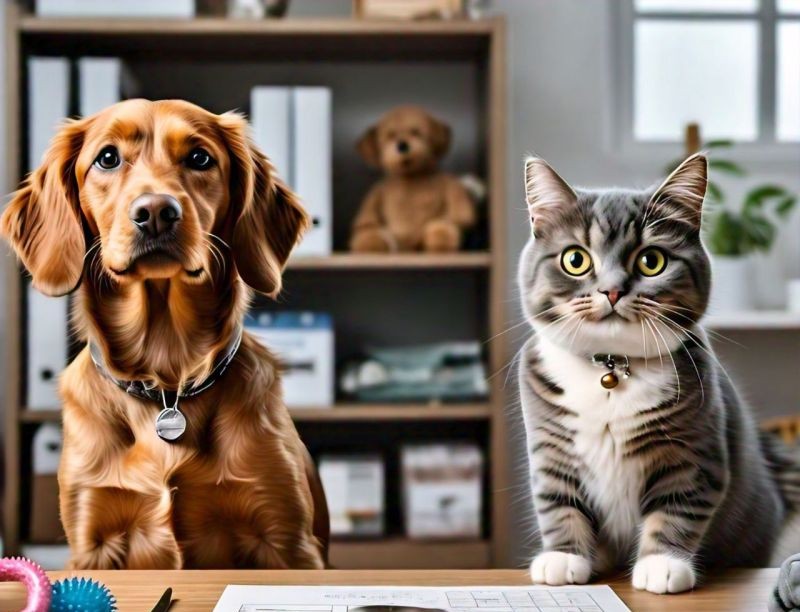
Cat vs. Dog Classifier
“The more we learn, the more we realize how much we don’t know.” - Aristotle
The Cat vs. Dog Classifier is a deep learning model designed to distinguish between images of cats and dogs. This project demonstrates the application of convolutional neural networks (CNNs) for image classification tasks.
Key Features
- Convolutional Neural Network (CNN): Designed with convolutional layers for feature extraction, max-pooling layers for dimensionality reduction, and dense layers for classification.
- Data Preprocessing: Applied data augmentation techniques like rescaling, flipping, and zooming to improve generalization.
- Model Training: Trained using binary cross-entropy as the loss function and the Adam optimizer for efficient gradient descent optimization.
- Testing & Validation: Validated the model with unseen images and tested it with new datasets to ensure robustness.
Technologies Used
- Python: The core programming language for the project.
- TensorFlow/Keras: Used for building and training the CNN model.
- OpenCV: For image preprocessing and visualization.
- Matplotlib: For plotting results and performance metrics.
GitHub Repository
Explore the code and implementation details on GitHub: Cat vs. Dog Classifier Repository.
Conclusion
This project showcases the power of CNNs in computer vision and image classification. It highlights the importance of data preprocessing and iterative model improvements. Suggestions for future work include experimenting with transfer learning and hyperparameter optimization.
Quick Notes
- Data augmentation improved generalization.
- Achieved significant accuracy with a basic CNN architecture.
- Potential enhancements: transfer learning, fine-tuning hyperparameters.